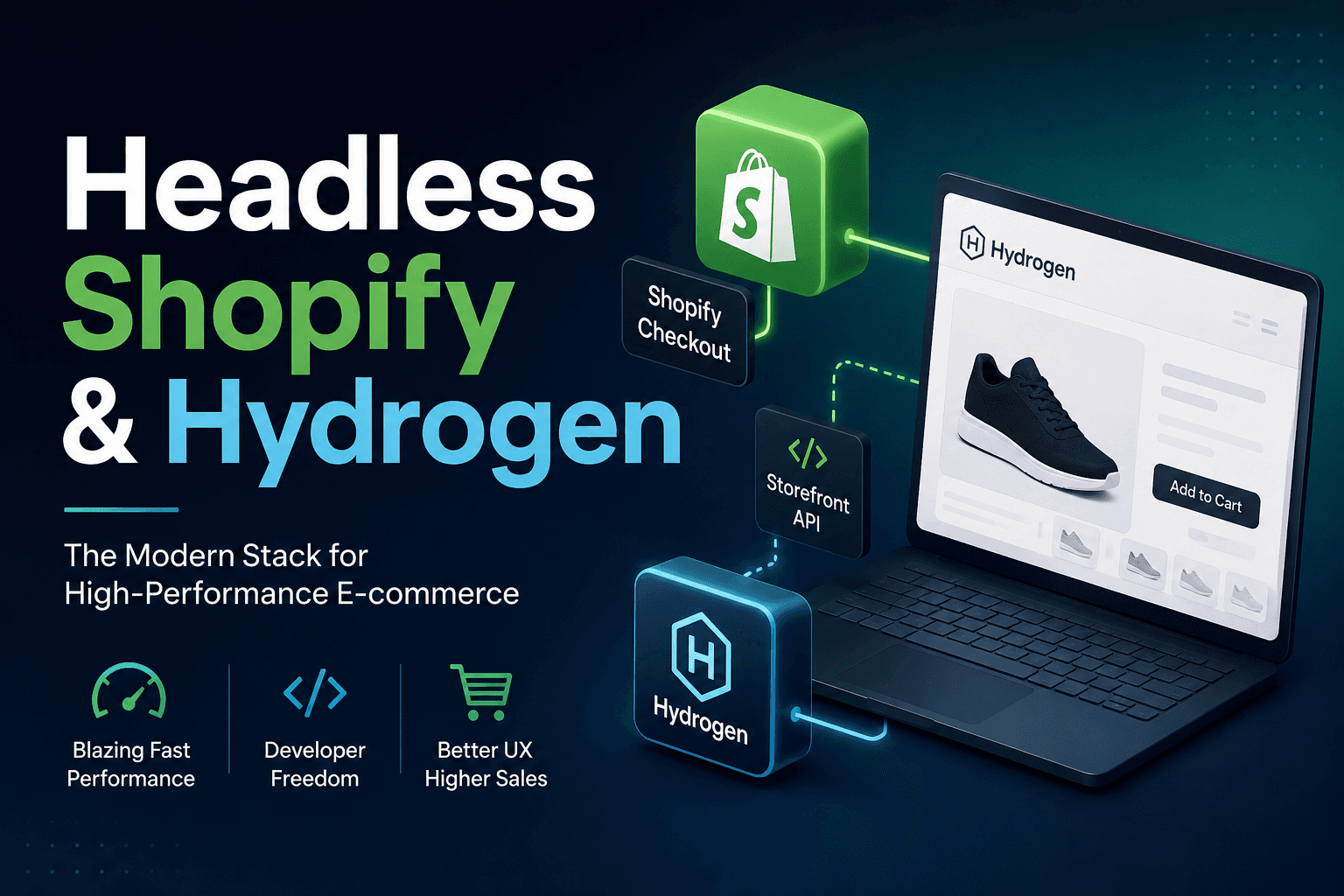
If you are considering building a headless Shopify with Hydrogen, you have probably hit the limits of what a standard Liquid theme can do. Maybe your product configurator runs sluggishly, your custom layout hacks keep breaking after updates, or your agency told you that going headless is the only way to get a 90+ mobile speed score.
Going headless sounds modern and clean on paper. But decoupling your frontend from Shopify introduces significant trade-offs that most agencies skip over during sales calls.
Before you invest thousands into custom React engineering, you need to know how Hydrogen works, what it solves, and where it bites back.
What Hydrogen Actually Changes
Traditional Shopify uses Liquid. Your theme templates, checkout logic, and catalog data all live together on Shopify servers. When a shopper visits your URL, Shopify renders the HTML and sends it down.
When you run headless Shopify with Hydrogen, Shopify handles your inventory, orders, checkout, and payments in the admin, while a custom React frontend renders the customer-facing site. Hydrogen is Shopify's official, opinionated framework built on top of Remix. It comes pre-wired to Shopify's Storefront API, caching layers, and hosting infrastructure (Oxygen).
Instead of editing .liquid files in the Shopify admin, your developer writes standard React components, handles server-side data loaders, and deploys code through Git.
Why Most Stores Do Not Need Headless
Nine out of ten stores asking me for headless do not actually need it. What they usually need is someone to clean up their messy theme.
Liquid themes get slow because founders install twenty apps that inject unoptimized JavaScript tags into the theme head. Moving to React does not automatically fix bad architecture. In fact, an unoptimized React app will score worse on Google Core Web Vitals than a cleaned-up Dawn theme.
Liquid has massive advantages for everyday operations:
- Non-technical team members can build landing pages using native theme customizers.
- Most third-party Shopify apps install with one click.
- Shopify manages all server uptime, scaling, and framework security updates.
Throwing away those features means your engineering team becomes responsible for every single button, page template, and marketing script.
When Headless Actually Makes Sense
There are situations where standard themes hit a brick wall. Teams that get the most return from headless Shopify with Hydrogen usually have multi-region complexity or bespoke design systems.
Here are three scenarios where Hydrogen is genuinely worth the overhead:
- Complex interactive experiences: If your catalog centers around a multi-step custom builder, custom 3D models, or real-time configuration logic, React handles state management vastly better than Liquid.
- Unified multi-platform storefronts: When you sell across web, native mobile apps, and point-of-sale kiosks, having a unified API-driven frontend layer prevents duplicating code across platforms.
- Granular sub-second page transitions: If instant client-side route transitions and fine-grained data caching directly impact your high-volume conversion funnel, Remix and Oxygen give you full control over every single HTTP request.
The Hidden Costs: Apps and Maintenance
Another surprise when adopting headless Shopify with Hydrogen is Shopify apps.
On a standard theme, installing an app like Judge.me, Klaviyo, or Back in Stock inserts scripts directly into your template. On a headless build, those apps do not work out of the box. You have to build custom UI components and query the app's private APIs or fetch data via metafields.
That means:
- Every review widget must be coded manually.
- Product recommendations need custom API integrations.
- Marketing teams cannot spin up quick landing pages without developer support, unless you connect a headless CMS like Sanity or Builder.io.
Your ongoing maintenance budget increases. You are no longer maintaining an online store; you are maintaining a custom web application.
Making the Right Call for Your Store
Committing to headless Shopify with Hydrogen makes sense only when your custom requirements drive real revenue that covers the engineering overhead.
If your annual store revenue is under a few million dollars, or if your marketing team relies heavily on theme customizers, stick with modern Shopify Liquid. You can achieve excellent performance by auditing apps, using theme app extensions, and optimizing images.
If you have outgrown Liquid's layout limits and need full control over the runtime environment, Hydrogen provides the best developer ergonomics available for Shopify today. Just go in with your eyes open to the development and maintenance reality.