Freelance Web Developer vs Agency: Which One Is Right for Your Business and Budget
Freelancer or agency for your website project? An honest comparison of cost, speed, and risk from someone who has worked both sides of it.
Murad Raza
Freelance Full-Stack Developer
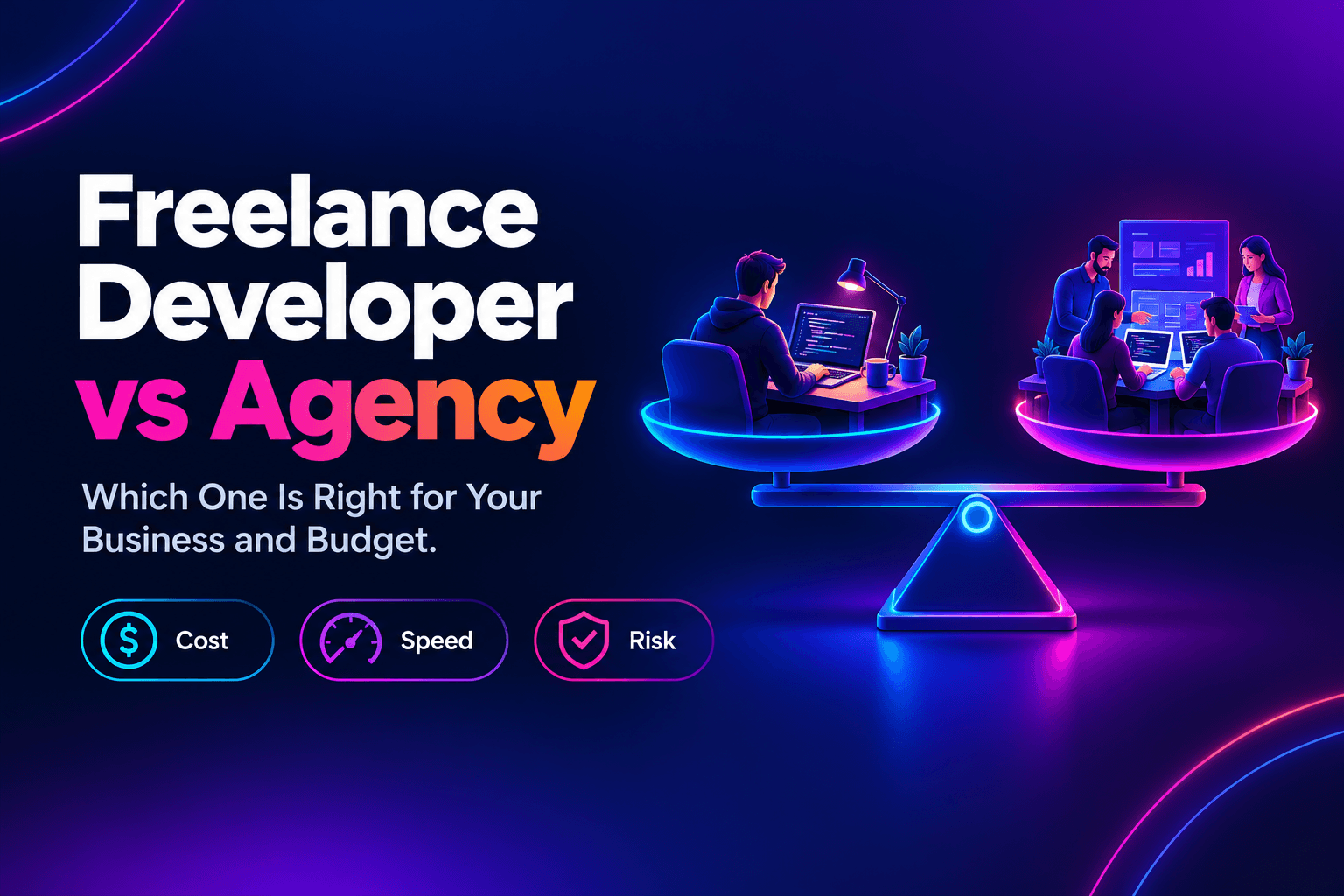
"Should I hire a freelancer or an agency?" usually gets answered with whichever side the person answering happens to be on. A freelancer will tell you agencies overcharge for overhead. An agency will tell you freelancers disappear mid-project. Both complaints are sometimes true, which is not a useful way to decide.
Here is a more honest comparison, covering what each option actually trades off against the other.
Cost: The Difference Is Real, and It Is Mostly Overhead
A freelancer's pricing reflects their own time and skill. An agency's pricing reflects the same thing, plus account managers, office overhead, and a markup that funds the business beyond the person actually doing the work. For comparable skill level, a freelancer is almost always meaningfully cheaper, often by a significant margin, simply because there are fewer people between you and the work.
This does not mean agencies are a bad value. It means you are paying for something beyond the raw development work, which may or may not matter for your specific project.
Speed and Communication
With a freelancer, you typically talk directly to the person doing the work. Decisions and clarifications happen in one conversation instead of being relayed through an account manager to a developer and back. For most small business projects, this makes freelancers meaningfully faster to work with.
Agencies can match this speed with the right team and process, but it depends heavily on the specific agency. Bureaucracy between you and the actual builder is the most common complaint about agency work, and it is a real risk, not a stereotype.
Risk: Where Agencies Genuinely Win
This is the honest tradeoff in the other direction. If a freelancer gets sick, takes on too much work, or simply disappears mid-project, you have no backup. A reasonably run agency has redundancy: if one developer is unavailable, someone else can pick up the work.
For a mission-critical project with a hard deadline and significant budget at stake, that redundancy has real value. For most small business websites, the risk is lower than people assume, but it is not zero, and it is worth weighing honestly rather than dismissing.
Scope and Scale
Agencies are generally better suited to very large, multi-discipline projects: a full brand overhaul alongside a complex web application alongside an ongoing marketing retainer, for example, where coordinating multiple specialists under one roof has real value. A freelancer specializing in web development is usually the better fit for a focused project: a business website, an e-commerce store, a redesign, where you need one clear skill set executed well rather than several disciplines coordinated together.
How to Actually Decide
A few honest questions help more than general advice:
- How big and complex is the actual project? A single business website rarely needs an agency's coordination overhead. A multi-channel campaign with several moving pieces might.
- What is your real budget? If agency pricing is simply out of reach, a skilled freelancer with strong reviews is very often the better option, not a compromise.
- How much redundancy do you actually need? A hard launch date tied to a major event raises the value of agency-level backup. A flexible timeline lowers it.
- Have you checked the freelancer's track record? A freelancer with verifiable reviews, a real portfolio, and a platform history like Top Rated status on Upwork carries much of the same risk-reduction an agency offers, without the markup.
The Honest Recommendation
For most small business websites, a skilled, well-reviewed freelancer delivers the same quality as an agency at a lower cost and often faster, because you are paying for the work itself rather than the layers around it. The agency premium earns its keep on large, multi-discipline projects with hard deadlines and real redundancy requirements. Most business websites are not that.
Comparing your options for an upcoming project? See our services or get in touch directly to talk through what your specific project actually needs.
Frequently asked questions
Need this fixed on your site?
I Build Websites That Work as Hard as You Do